
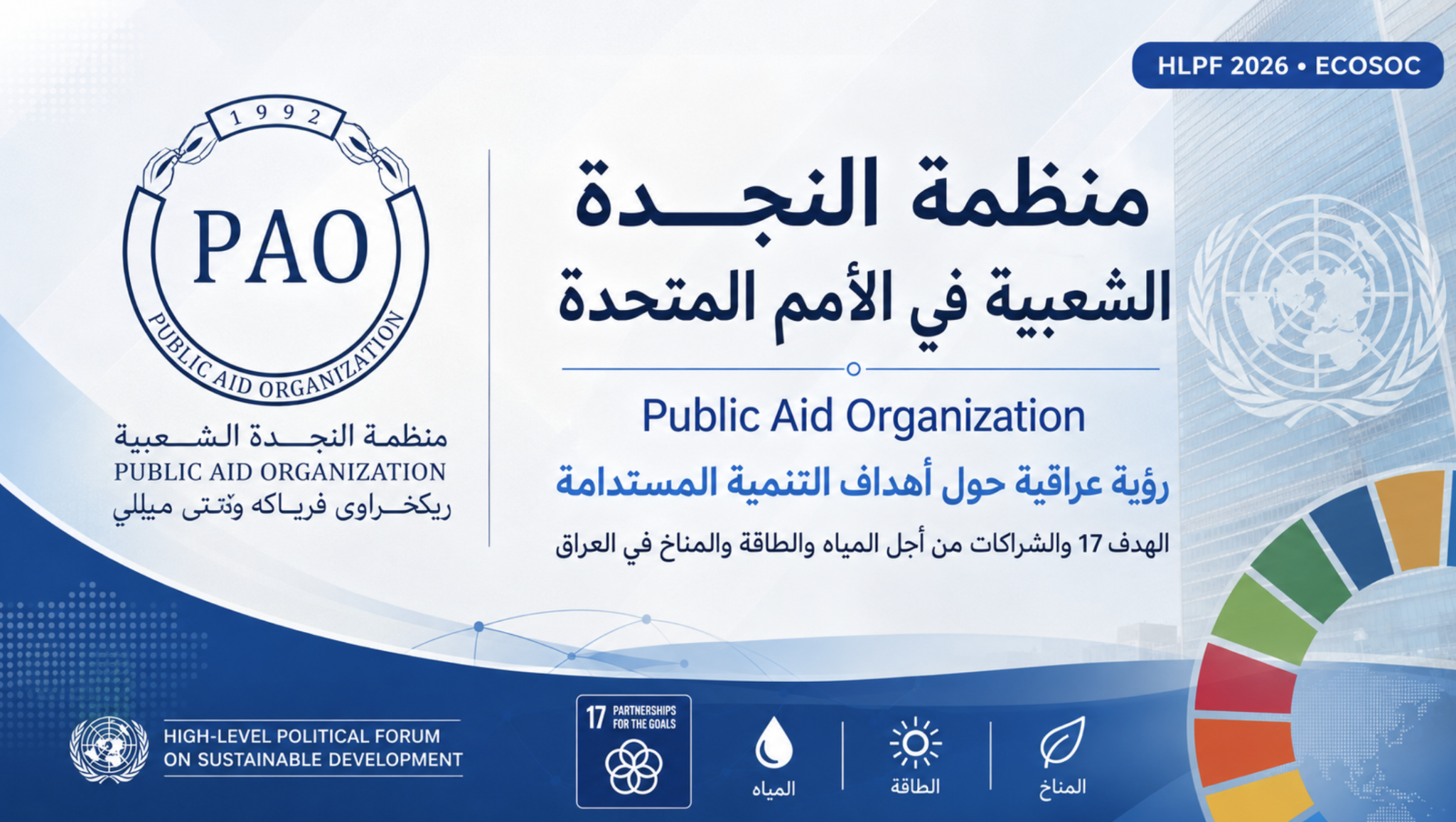
The Public Aid Organization (PAO) affirmed that achieving the Sustainable Development Goals (SDGs) in Iraq requires moving beyond commitments toward effective and inclusive partnerships. This message was delivered during PAO’s statement at the High-Level Segment of the United Nations Economic and Social Council (ECOSOC) and the 2026 High-Level Political Forum on Sustainable Development (HLPF), held at the United Nations Headquarters in New York from 13–16 July 2026 under the theme: “Advancing sustainable, inclusive, science- and evidence-based solutions for the 2030 Agenda for Sustainable Development and its Sustainable Development Goals, leaving no one behind.”
PAO’s participation came as the Forum reviewed five key Sustainable Development Goals: Clean Water and Sanitation (SDG 6), Affordable and Clean Energy (SDG 7), Industry, Innovation and Infrastructure (SDG 9), Sustainable Cities and Communities (SDG 11), and Partnerships for the Goals (SDG 17).
During its intervention, PAO presented a practical vision for strengthening national and international partnerships capable of addressing Iraq’s development challenges through the “Basra Principles”—a framework derived from the Basra Charter that promotes cooperation among government institutions, civil society, the private sector, academia, and international partners.
PAO emphasized that the Basra Principles are built upon several key pillars. Foremost among them is ensuring the institutionalized and meaningful participation of civil society organizations in the preparation of national policies, strategies, and SDG reports, recognizing civil society as a genuine partner in decision-making rather than a participant in symbolic or late-stage consultations.
The Organization also called for the establishment of a permanent national coordination mechanism that brings together Iraqi government institutions, the United Nations, the private sector, universities, professional associations, and civil society organizations to oversee and coordinate programmes related to water, energy, climate action, and infrastructure, ensuring greater coherence and accelerated implementation.
Highlighting the importance of accountability, PAO stressed that transparency is the cornerstone of successful partnerships. It urged the publication of accessible, up-to-date, and verifiable data on water resources, electricity, greenhouse gas emissions, desertification, and development expenditure to support evidence-based planning and strengthen public accountability.
On financing, PAO called for the adoption of flexible and direct funding mechanisms that enable local organizations, particularly youth-led and grassroots organizations—to implement impactful initiatives in environmental awareness, water conservation, solar energy, and support for communities affected by drought and climate-induced displacement.
In concluding its statement, PAO reaffirmed that Iraqi civil society does not seek to replace state institutions, but rather to be recognized as an independent and responsible partner with the capacity to reach local communities, identify their needs, provide expertise and knowledge, strengthen accountability, and foster trust between citizens and public institutions.
#PAO